
Nordic transgender policy changing
A new Finnish law banning discrimination of transgender persons went into effect 1 January. The country’s LGBT movement welcomes the initiative, but has no time to celebrate. New laws are meant to improve the conditions for trans persons in the Nordic region, but are they successful? NIKK asked activists in Finland, Norway and Sweden.
The new Finnish law bans discrimination based on gender identity and gender expression.
‘It’s a very important law, but it has been pushed aside a bit,’ says Arja Voipio, co-chair of Transgender Europe.
Instead the attention is turned to another law. Today Finland requires trans persons wishing to change their legal gender to get sterilised.
‘The state shouldn’t make that kind of requirement. You shouldn’t have to sacrifice the possibility of having biological children in order to be recognised by the state,’ says Voipio.
The sterilisation requirement is being criticised in a current review of the law, but a change is not supported by the present government.
‘We’re in a deadlock despite the strong support for change. I guess Finland is not very eager to legislate on human rights,’ says Voipio.
‘We should have the right to our own bodies’
The sterilisation requirement has been on the political agenda in all Nordic countries in recent years. It has been removed in Sweden and Denmark but remains in Finland and Norway. Finland requires sterilisation through hormone therapy whereas Norway requires non-reversible surgical sterilisation. Luca Dalen Espseth, from the Norwegian organisation LLH, wants to see a change.
‘We should have the right to our own bodies and be recognised for who we are. It should be obvious,’ he says.
The gender recognition legislation is being reviewed in both Finland and Norway. Dalen Espseth hopes that the sterilisation requirement will be removed.
‘I’m looking forward to following the development this year. I hope and believe we’ll get a new law,’ he says.
The Danish legislation stands out

Out of the Nordic countries, Denmark has the newest gender recognition legislation. Only Denmark does not require a diagnosis or confirmation from a psychiatrist in order to change a person’s legal gender. Since last summer, all a person needs to do is send in an application and confirm the wish after a six-month waiting period. This makes the country a leader in a European perspective, says Swedish equality consultant Lukas Romson. Sweden removed the sterilisation requirement in 2013 but still requires a note from a psychiatrist – in practice a diagnosis – in order to change a person’s legal gender.
‘The entire LGBT movement is against this,’ he says.
The issue has been subject to review, and a proposal to revoke the diagnosis requirement was recently presented to the parliament. The review committee also questions the 18-year age limit for changes of legal gender. The Swedish trans-specific healthcare is also being reviewed and the National Board of Health and Welfare is expected to present new guidelines this spring,’ says Romson.
Dalen Espseth hopes that Norway will follow Denmark and stop requiring a diagnosis for changes of legal gender. He describes the Danish legislation as progressive but is critical to the country’s healthcare situation. Weaknesses in trans-specific healthcare are pointed out in all Nordic countries, but the problems are particularly severe in Denmark and Norway, says Dalen Espseth and explains that it takes a long time to process applications, the level of patient participation is low and there are strong expectations that the patient should undergo certain procedures. Up to 60-80 per cent of all transgender persons who seek medical care in Norway are denied.
‘That’s terrible. There can’t possibly be an acceptable reason for denying that many people treatment.’
‘Nobody wants to be worse than their neighbours’

The fact that several Nordic countries are now, almost at the same time, reviewing and changing their gender recognition legislation is hardly a coincidence, says Dalen Espseth. Politicians in the different countries are watching each other and this is leading the development in the right direction.
‘Nobody wants to be worse than their neighbours. The Danish legislation ended up better than the Swedish, and the Norwegian will probably be better than the Danish,’ he says.
At the same time, he sees issues being discussed in other parts of the world that are not on the Nordic political agenda at all. The possibility of introducing additional categories of legal gender is one example.
‘The Western world is stuck in the binary notion of gender. Some other parts of the world are more open to the idea that there are not only women and men,’ he says.
Back to Finland and the new antidiscrimination law: While the Swedish equivalent from 2009 refers to discrimination based on, directly translated, ‘gender-crossing’ identity or expression, both Arja Voipio and Lukas Romson are happy that Finland instead chose the formulation ‘discrimination based on gender identity and expression’.
‘It includes everybody. The Swedish formulation is based on the norm and points out certain individuals as crossing boundaries,’ says Romson.
Another advantage of the Finnish discrimination act is that it includes a requirement for preventive measures, which means that Finnish schools and employers now have to work actively against discrimination of trans persons. This can make a big difference, says Voipio.
Despite the setback with the Finnish gender recognition act, she believes that change is on its way in all Nordic countries.
‘A lot has happened in just the last five years. The human rights of trans persons have become a broadly discussed issue, so I’m hopeful,’ she says.
- Text: NIKK
- Categories: Gender equality and welfare policy
- Published: 2015-02-12

’The Nordic countries need more Feminist Initiatives!’
The Nordic countries should use their position to promote a more advanced discussion on gender equality and equal treatment, said Gudrun Schyman at a gender equality seminar in Helsinki last week.
Schyman, leader of the Swedish political party Feminist Initiatives, also criticised Finnish politicians for being too consensus-driven, saying it makes for toothless equality policy.
With reference to a panel discussion held earlier in the day, where representatives from eight parties participated, Schyman noted that the level of consensus was remarkably high. She also thought that the politicians on the panel had problems sticking to the core issue, which she said is typical when gender equality is discussed.
‘There’s a common notion that we all agree when it comes to gender equality and that we therefore don’t need to talk about it. At the same time it becomes evident how multifaceted the issue is. We need to rise up from the consensus soup!’
‘If the Finnish parties were as unanimous as they make it seem about the lack of gender equality being a problem, they would already have fixed it.’
Wants advanced discussion
According to Schyman, the Nordic countries should take advantage of their strong position and sophisticated welfare systems and instigate a more advanced discussion in the area of gender equality and equal treatment.
‘Politicising the gender equality issue is a way to move forward. Knowledge-transfer and organisation of effective opinion formation are also beneficial. The Nordic region needs more Feminist Initiatives,’ said Schyman, hoping that a Finnish party will take on the role as an explicitly feminist party in the parliamentary election this April.
‘The gender equality problem does not belong at the individual level. It has to do with social conflict. And the role of politics is to solve conflicts that are structural in nature, and not to create additional structures that cause problems,’ she said.
The resistance against true gender equality is according to Schyman related to coercive power patterns and structures in society that need to be made visible in all of our relationships, since they affect us from the cradle to the grave.
‘These key issues are often avoided. We need to ask ourselves who will benefit from things remaining as they are today.’
Violence against women – a disgrace
Several Finnish ministers attended Wednesday’s all-day seminar. Violence against women was described as a disgrace to the entire Nordic region.
‘The violence against women is an enormous problem. The money issue alone should be an incentive: It is estimated to cost Finland 90 million euro per year,’ said gender equality minister Susanna Huovinen.
She presented a final report of the current government’s gender equality policy 2012-2015. The report includes 66 measures to promote gender equality and eliminate gender-based discrimination in for example legislation, the labour market, education, citizen influence, economic matters, health and integration policy. The report also assesses the ministries’ success in reaching their targets. The assessment can be summarised as follows: Progress is being made. But far too slowly.
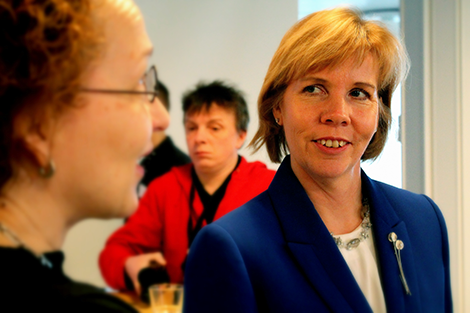
During her speech at the seminar, Minister of Justice Anna-Maja Henriksson proposed increased funding to crime victim support. She also proposed that a so-called crime victim fee be introduced. Such a fee would be mandatory for individuals found guilty of crimes that may result in jail time and would be used to fund support services for crime victims. She got the idea from the Crime Victim Fund in Sweden.
‘I cooperate a lot with my Nordic colleagues. Iceland and Sweden also have a model for parental leave that we need to look closer at and then try to create a flexible model that’s right for Finland,’ she said.
‘Gender equality – a matter of interpretation’
Finland differs from the other Nordic countries on several issues concerning the rights of same-sex couples and transgender persons. The country adopted a citizen initiative on gender-neutral marriage only last autumn. The final report on the Finnish government’s gender equality programme mentions increased equality for, among others, sexual and gender minorities as an important support measure to promote gender equality. Still, the Christian Democrats, one of the government parties, recently shot down a proposed new motherhood law that would have made it easier for same-sex female couples who would like to become parents.
The law would have made women in same-sex registered partnerships exempt from the internal adoption process. Also cohabiting two-mother couples would have been able to confirm the other parent’s motherhood when no father confirms fatherhood. Jouko Jääskeläinen, who represents the Christian Democrats in the parliament, thinks that the work to improve equality between women and men becomes more difficult when issues concerning sexual minorities and gender minorities are thrown into the equation.
‘As we see it, what to include in gender equality work is a matter of interpretation. Our opinion differs from the interpretation stipulated in the gender equality programme and in the proposed new motherhood and marriage legislations,’ he says.
Minister of Justice Henriksson regrets that the proposed new motherhood legislation did not go through. Now it is up to the next government to address the issue, ‘if there’s a will’.
- Text: NIKK
- Categories: Gender equality and welfare policy
- Published: 2015-02-10

Many Cooks in the Gender Equality Kitchen
Gender equality has traditionally been considered a left-wing issue. But things have changed, and today the concept is addressed across the political scale all the way out to the far right. What happens when new groups want to be part of defining gender equality? This is what the researchers, politicians and practitioners in a new Nordic network are looking closer at.
Challenges and opportunities within Nordic gender equality policy and in the practical gender equality work will be discussed at four seminars. Ulf Mellström, professor of gender studies at Karlstad University, is coordinating the network. He has witnessed the emergence of increasingly complex gender equality policy in the Nordic region.
In what way has it become more complex?
‘Gender equality used to be defined within a framework of state feminism and had close ties with the welfare state. What we see today is some type of market feminism, with new focus areas. In short, it can be described as a breakthrough for the more right-wing feminism. Today gender equality is embraced by more people and groups than in the past. Even far-right political parties are using gender equality in their defence of the nationalist project.’
What are the consequences of this?
‘That’s hard to say. It depends on your political perspective. Some people think it’s good that the analysis reaches new areas. Others say that the concept of gender equality loses its meaning when more and more groups, such as the far-right Sweden Democrats, want to be part of defining what it is. From now on I think we can expect an increasing presence of the nationalist movement in the gender equality debate. This change is already noticeable in other parts of the world. Turkey’s Prime Minister Erdogan for example believes that it is the responsibility of each patriotic woman to give birth to 3-4 kids. These types of ideas for gender policy are gaining ground and may grow stronger also in the Nordic countries.’
What other challenges can be noted in relation to Nordic gender equality policy?
‘Nordic gender equality policy has traditionally been tailored to a white, heteronormative, middle class. Many political reforms have targeted the nuclear family. For example, parental allowance reforms, the marriage legislation and the income taxation system have all been designed with hetero families in mind. Not everybody has been included in the development of gender equality policy, so there are indeed some big challenges. We need to broaden the perspectives and recognise that there may be needs out there that are not given enough attention today.’
What effects are you hoping your project will have?
‘We want our results to be policy relevant. It should be possible to use them immediately in policy work. The project will include four seminars and we will also publish one or two books. In a best-case scenario, our work will result in an application for a major EU project so we can involve researchers from other European countries as well.’

This is an article about one of the projects granted funding through the Nordic Gender Equality Fund.
- Text: NIKK
- Categories: Gender equality and welfare policy
- Published: 2015-02-05

Cooperation Will Improve the Police Work Against Violence
The police must become better at spotting human trafficking and gender-based violence, according to the Nordic-Baltic Network of Policewomen. Tomorrow they will meet in Copenhagen to discuss new tools for the police work.
Detective inspector Berglind Eyjólfsdóttir is chairing the network, which gathers police women from across the region. The network’s project Gendered Violence – Nordic-Baltic Dialogue aims to develop new methods for the police work. The seminar tomorrow is part of the project and Eyjólfsdóttir hopes it will be an eye-opener.
‘We need to compare and improve the methods we use to combat human trafficking and all forms of gender-based violence,’ she says.
What do the Nordic and Baltic police have to gain from the cooperation?
‘Since our countries are neighbours in such a small area, we depend on good cooperation. Our investigations become so much more effective if we know each other. This is important in the work against human trafficking in particular, but also in other areas. The work against violence in close relationships can for example benefit a great deal from sharing of strategies and experiences across national boundaries.’

What’s going on in the project at the moment?
‘We will meet in Copenhagen 3-4 February for a seminar on the work against gender based violence. We’re also planning next autumn’s final conference in Riga. It will gather police as well as other experts from the Nordic-Baltic region working daily to combat all forms of violence.’
How can the police work against human trafficking and violence in close relationships be improved?
‘Through more education. For a long time, violence within the family was considered a private matter, and the knowledge about it is still limited in many cases within the police. We need to understand the seriousness of these types of crimes and become better at identifying the victims.’
Shouldn’t this work be part of the regular police operations instead of a special project?
‘There is indeed ongoing police work in this area. Our project should be seen as a complement. Nordic-Baltic Network of Policewomen helps emphasise issues that we believe should be given more attention. It may be about women’s situation within the police or, like in the case of this project, special issues that we feel should be addressed with greater force.’
What’s the biggest challenge in the work against gender-based violence?
‘There’re a great number of challenges. It’s particularly important to improve the cooperation between the police and other relevant actors, such as social services and healthcare. Our ability to discover these crimes at an early stage depends on co-operation with all actors combating gender-based violence including NGOs.’
This is an article about one of the projects granted funding through the Nordic Gender Equality Fund.
- Text: NIKK
- Categories: Gender equality and welfare policy
- Published: 2015-02-02
Denmark to Lead the Nordic Cooperation
Getting more girls to break the gender pattern and pursue studies in science, technology, engineering and math. That is one of the focus areas for the Nordic gender equality cooperation under the Danish Presidency.
‘The public space’ and ‘welfare and innovation’ are two central themes for the Nordic gender equality cooperation. Denmark is heading the Nordic Council of Ministers during 2015 and will lead the work this year. The Danish Presidency has already planned a number of activities. For the theme welfare and innovation, one key objective is to reduce the strong gender patterns in adolescents’ educational and occupational choices. The plan is to find and share positive examples of how to encourage more young women to pursue studies in science, technology, engineering and math.
‘Most Nordic boys and girls are still making educational choices along traditional gender lines. It is very unfortunate, both for the individuals themselves and for society at large, that their potential is not fully utilised,’ says Manu Sareen, Denmark’s minister for gender equality and social affairs.
Good examples in new handbook
Nordic higher education institutions are already trying to make more girls interested in the natural sciences. For example, Denmark has been successful with Girls’ Day in Science, an education fair targeting teenage girls who are about to decide which track to pursue at the upper secondary level. The fair enables the girls to meet representatives from different companies and learn about their work. They are also offered internships.
‘Our experience is that the girls’ attitudes often change when they discover what the companies really do. They become more prone to breaking away from traditional, gender-based expectations,’ says Sareen.
He emphasises that more educational institutions and actors need to address this problem. Denmark wants to carry out a larger research project where good examples are identified and documented. The plan is to ultimately publish a handbook in all Nordic languages.
Women are leaving the countryside
Another issue that falls under the welfare theme is the urbanisation trend, where a high proportion of young Nordic women leave rural areas to study at a university in a larger city. By contrast, men are less likely to move to the cities and if they do, they are more likely to return home after they get their degree. At the same time, however, the traditionally male-oriented job opportunities are becoming increasingly scarce in rural areas, leaving many men destined for unemployment.
‘This can lead to depopulation of some communities. Birth rates go down, homes deteriorate and the local life just kind of fades away. As there’s a clear connection between population flows and gender equality issues, we want to focus on this and discuss how the problems can be solved,’ says Sareen.
The Danish Presidency has appointed a research project to assess the challenges. Since the problem is substantial in the Faroe Islands and Greenland, a seminar for various actors will be held in Greenland in the summer. The results from the seminar, together with useful advice and positive experiences, will be documented and disbursed across the Nordic region.
Sexist remarks– a democracy problem

‘Gender equality in the public space’ is another key theme in the Nordic cooperation. 2015 marks the 100-year anniversary of women’s suffrage in Denmark and Iceland. In Finland, women were allowed to vote already in 1906. This means that the Nordic countries have a long tradition of female representation in politics. However, the representation in the public space remains unequal. One example of this, according to Sareen, is the way women are discussed and treated in media and social networks.
‘We can see a growing trend where women who participate in the public debate increasingly have to endure sexist remarks, trash talk and direct threats. It’s totally unacceptable. Women and men should be able to participate in the public debate on equal terms. If they can’t, we have a serious democracy problem.’
‘Gender equality in the public space’ is a broad theme that covers both representation, sexism in everyday life, anti-feminism and gender equality in media. The exact focus issues will be decided at the meeting of the Nordic Council of Ministers in May. The selected issues will then be addressed through expert seminars, which may result in the formulation of potential solutions.
‘There’s so much that can be done. I’m looking forward to talking to my Nordic colleagues about how we can improve gender equality in the public sphere,’ says Sareen.
- Text: NIKK
- Categories: Gender equality and welfare policy
- Published: 2015-01-29
Opinion: Together we can eliminate gender stereotypes
In 2014, the Nordic Council of Ministers marked the 40-year anniversary of the Nordic gender equality cooperation – a fruitful initiative that has played a significant role for the repeated success of the Nordic countries in various international gender equality rankings. The results speak for themselves: Nowhere in the world do men and women live as equal lives as in the Nordic region. Now it’s time to take another step forward.
Throughout the four decades of Nordic gender equality cooperation, there has been a continuous focus on equal rights and equal status for women and men in the labour market. Attention has been given to the gender pay gap and elimination of traditional gender roles in the labour market. The possibility to combine paid work and family life has been of critical importance in this work. Today equal sharing of parental responsibilities between mums and dads is increasingly taken for granted, and the high employment rate among Nordic women is contributing largely to the Nordic welfare model.
Many steps remain for the Nordic countries to achieve gender equality in the business sector. Their parliaments, however, have come farther. The Nordic countries share many views and objectives, but often choose different methods to get the work done. That is why they can learn so much from each other.
In the next few years, the Nordic gender equality cooperation will change gears somewhat. In the cooperation programme for 2015–2018, we want to give particular focus to gender equality in the public space – because democracy is not just a matter of having the right to vote, it’s also about being able to participate in the public debate.
Words contribute to form our reality, and when we begin to allow the use of belittling and disrespectful rhetoric and remarks, the practice soon becomes generally accepted. We simply don’t want to be part of such development, but instead work against it, in the same way as we have worked against for example domestic violence for many years. As we also know that gender equality contributes to sustainable growth, we want to give increased attention to gender equality as a driver of welfare and innovation in the Nordic countries.
Nordic gender equality policy has so far focused mostly on the situation of women in society, politics and the labour market. In order to eliminate the stubborn boundaries between so-called male- and female-oriented occupations and educational choices, the male perspective has to be included in the work. We need to find more methods to combat the stereotypical preconceptions that keep affecting the lives and life choices of women and men, boys and girls. In the coming years, we will therefore work hard to facilitate men’s and boys’ active participation in the gender equality work and the gender equality debate
The new programme for the gender equality sector in the Nordic governmental cooperation does not imply a change of direction of Nordic gender equality policy. It is our way to concretise the cooperation between the Nordic governments in the area of gender equality. The programme has been developed with the assistance of both theparliamentarians in the Nordic Council and gender equality actors from around the Nordic region, and is therefore broadly supported. Backed by this support, we are also sharing our experiences in the UN and other international arenas.
Gender equality themes addressed by the Nordic countries tend to spread and find their way to national agendas also outside the Nordic region. However, the good experiences and examples need to be spread in our own sphere as well – in politics, in the workplace and in people’s homes. By together letting the principles of gender equality guide the way we think and act, we – politicians and citizens – can bring our countries even closer to the ultimate goal of a just and democratic Nordic region.
- Text: NIKK
- Categories: Gender equality and welfare policy
- Published: 2015-01-26
Nordic Women’s Network for Economic Gender Equality
Incomes that vary with gender and pensions that are too low to cover a person’s basic needs. That’s the reality people in the Nordic region are facing today. Several women’s organisations are now joining forces to intensify the debate on economic equality between men and women.
Women’s economic conditions have changed fundamentally in just a few decades, but the goal remains to be reached in the Nordic countries.
‘Economic equality is not some fringe problem. It’s actually a key factor if we want to get somewhere with the gender equality work,’ says Louise Lindfors, chair of the Fredrika-Bremer-Association.
Why did you start the project?
‘The economic issues are critical to the Nordic gender equality work. When the World Economic Forum measures gender equality in different countries (in the annual Global Gender Gap Report) the Nordic ones end up at the top of the list, but serious problems are also revealed. Our score for representation, for example in politics, is high, but when it comes to the economic domain our ranking is not nearly as high.’
Why are we ranked lower in that area?
‘In a nutshell, men tend to have more money to spend than women. There’re several reasons for this. One in three women work part time; for men it’s one in ten. Women take out 74 per cent of the parental leave and are also more likely to stay home from work with sick kids. And then of course there are the pay differentials – men’s work is assigned a higher value than women’s.’
What will it take for the Nordic countries to achieve economic equality?
‘We need to close the pay gap and reach a more gender equal distribution of family and household responsibilities. The introduction of a daddy month (one month of the total parental leave reserved for the father) is the single most important gender equality measure in Sweden. Everybody knows this, so it should be easy to realise that more work in this area can have a major impact. The politicians are afraid of telling people what to do, but it’s really a matter of communicating what’s expected. A shared parental leave policy would signal that equal sharing is the default way of doing it.’
You talk about economic vulnerability. Do the weaknesses in gender equality really have such serious economic consequences?

‘Yes. Look at our older people and you’ll find a particularly good example. In Sweden, about 225 000 senior citizens live below the EU poverty level. Most of them are women. The limit is set at a gross income of SEK 10 400 kronor and there are a large number of older people in Sweden who don’t come close to this level. A person’s economic situation depends on many factors, and gender is a big one. Sometimes we’re told the Nordic countries are close enough to perfect gender equality. We disagree, to say the least.’
Do you feel it’s difficult to reach out with these issues?
‘This is complex stuff so, yes, it’s a communicative challenge. We have some wild plans for how to explain things without coming across as dictating to people how they should live their lives. To reach out broadly I think we need to find ambassadors. At the Fredrika-Bremer-Association, we have for example worked together with the comedian Bianca Kronlöf. She can obviously reach out to people in a way that we at the Association simply can’t.’
This is an article about one of the projects granted funding through the Nordic Gender Equality Fund.
- Text: NIKK
- Categories: Gender equality and welfare policy
- Published: 2015-01-22

The daddy quota – the most effective policy instrument
In the book Fatherhood in the Nordic Welfare States – Comparing Care Policies and Practice , 25 researchers describe modern fatherhood in the Nordic countries and how Denmark, Finland, Iceland, Norway and Sweden support men in taking an active role in the parenting of their children. NIKK has talked to Professor Tine Rostgaard, one of the two editors of the book.
The Nordic welfare model, where society actively supports gender-equal participation in both parenting and the labour market, continues to attract international attention. The five Nordic countries are generally considered to be rather homogenous and advanced in the area of social and family policy. However, new research presented in the book Fatherhood in the Nordic Welfare States shows that although the countries do share many features, there are also important differences. Professor Tine Rostgaard from Aalborg University wrote several chapters of the book and also edited the entire work together with Professor Gudný Björk Eydal, University of Iceland.
‘One thing that all Nordic countries have in common is that they have tried to make it easier for fathers to participate actively in family life. Denmark and Sweden are at opposite ends of the Nordic continuum. In some of the countries – Denmark in particular – the concept of gender equality is mostly of symbolic importance and not something that’s concretely implemented in national policy. By contrast, Sweden has worked actively for many years to promote gender equality and active fatherhood through policy and legislation. Iceland, in turn, has been extremely progressive when it comes to parental leave. In 2013, Iceland passed a law reserving 5 months for the mother, 5 months for the father and 2 months to share any way they want, putting them at the forefront in this area,’ says Rostgaard.
A new government has, however, reverted back to the previous policy of 3 months for each parent and 3 months to share. Finland and Norway place somewhere in the middle of the field, Rostgaard explains. Finland has a high share of women working full time in the labour market, while Norway has a more traditional model where a series of family policies give women opportunities to stay home with their children.
Daddy quotas: An effective policy instrument
Fathers’ access to paid parental leave, the so-called daddy quota, is one of the central areas addressed in the book. In all Nordic countries except Denmark, fathers are legally entitled to shorter or longer periods of the total parental leave granted for a child. Against the background of the extensive research results presented in the book, Rostgaard has no doubts: The daddy quota can strengthen fathers’ access to parental leave and also their paternal role.
‘If the goal is to get men to take out more parental leave, the daddy quota is the most effective policy instrument. A quota helps institutionalise important rights and affects all levels, including the workplace and family life,’ Rostgaard adds.
Groundbreaking fertility research among men
Men’s role in relation to fertility and the falling birth rates is one of the groundbreaking areas that the book explores by looking at men’s attitudes to family life and their view of when it is appropriate to have children.
‘The study shows that Nordic men are more tolerant regarding other men’s choice to postpone having children or to not have them at all. Based on the data we have access to, we can’t firmly say that tolerance means that people choose not to have kids. But our data does point in that direction. We therefore conclude that the greater tolerance affects whether you choose to have kids,’ Rostgaard explains.
At a time with a strong political focus on the falling birth rates, the book therefore underscores the importance of men’s attitudes when attempting to understand what determines fertility rates.
Family legislation treats mothers and fathers differently
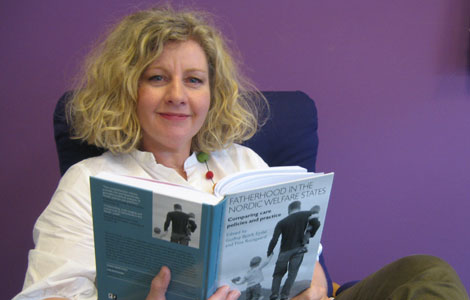
Other topics covered in the over 400 page book include men’s use of time at home, the paternal role in different family constellations and how policies in the five countries support the possibility for fathers to care for their children, as well as whether the results correspond to the Nordic countries’ aims in the areas of gender equality and family life. An article by Hrefna Fridriksdóttir, associate professor at the University of Iceland, shows that there are significant differences in how mothers and fathers are treated in Nordic family legislation.
‘We’re doing this big “daddy project” in the Nordic countries, but the family legislation doesn’t support the project to the same extent in all countries. Hrefna Fridriksdóttir concludes that greater efforts should be made to ensure that the family legislation is at par with the progressive thoughts that the Nordic countries demonstrate in the area of equality between mothers and fathers,’ says Rostgaard.
- Text: NIKK
- Categories: Gender equality and welfare policy
- Published: 2015-01-15

‘Sexual harassment is not part of the job!’
Many restaurant workers have to endure inappropriate remarks and unwelcome physical advances in the workplace. The perpetrators include both customers and co-workers. A group of Nordic trade unions are now launching a project to fight sexual harassment in the hotel, restaurant and tourism industry.
‘This is a hidden problem, but we want to start a debate about it,’ says Drífa Snædal, general secretary of the Federation of General and Special Workers in Iceland.
How is the sexism noticeable in your sectors?
‘Drunk customers groping staff is one example. Some guests think they have paid for the privilege of harassing the workers. Occupational groups that are dependent on tips, such as waitresses and cleaning staff, are particularly vulnerable. Studies show that harassment is a widespread problem in our sectors. We can’t just close our eyes to it.’
Why is sexual harassment so common?
‘Our sectors are characterised by strong hierarchies, both among workers and in relation to customers. Young women are often found at the bottom of the hierarchies. Then add alcohol to this. Many people think that these are problems that come with the territory, so to speak – as if it’s part of the job to take crap from customers and co-workers. That’s obviously not right.’
What will it take to stop the harassment?
‘The ultimate responsibility lies with the employers, but the unions also have a responsibility. We need to deal with this once and for all and spread information about it so that the victims feel they can come to us. It’s time for us to include this issue as a natural part of our work.’
What do Nordic trade unions have to gain from cooperating?
‘Good ideas often emerge in several places at the same time. This was definitely the case for us. Everybody who’s involved in the project sees a need to act, but we need better knowledge. The Nordic countries are known for their gender equality and like this role, but it takes a lot of work.’
What results are you expecting from the project?
‘We want to see a serious debate in the Nordic countries. In a long-term perspective, we hope that our project will lead to more and larger gender equality projects being formed.’
This is an article about one of the projects granted funding through the Nordic Gender Equality Fund.
- Text: NIKK
- Categories: Gender equality and welfare policy
- Published: 2015-01-13

Sami-Greenlandic Project for Gender Equality
Problems with violence and addictions are often swept under the carpet. Especially in small communities where everybody knows each other. Now Sami and Greenlandic women’s organisations are joining forces to address these troubling issues in their communities.
The project is the first collaboration ever between Sami and Greenlandic women’s organisations.
‘It’s really exciting. We share so many experiences,’ says Gudrun Eriksen Lindi from Sami Women’s Forum.
What do you think you can learn from each other?
‘Greenland has dealt differently with the violence and addictions problems than we have. Where we’re from, these issues are still taboo. The problems are by no means unique to our communities, but since we live in small communities it’s often hard to talk about them. There’s this idea that these problems should be solved in the family, but that’s wrong.’
What will it take to break these taboos?
‘We have to talk about the problems, not least with our adolescents. We need to teach them where the limits are. We can’t tolerate that boys harass girls in school, we have to give a clear message from the beginning. Both the authorities and our communities have a responsibility. They need to disperse information and be prepared to deal with the problems. Individuals who come to them and ask for help must be taken seriously.’
Being a woman and belonging to the indigenous population, does it imply any particular challenges?

‘We have to fight for our rights both as women and as indigenous people. In our culture, women often have a special responsibility to take care of the family and to carry on traditions. That’s a rather heavy burden now when our communities are in crisis. We’re being exploited, for example through the opening of new mines. We’re fighting the mining companies at the same time as we’re fighting for our rights as women. This fight involves both the Sami parliaments and the states. One thing that makes it harder is that we don’t have access to all democratic arenas.’
In which way do you mean you’re excluded?
‘The Sami are sidelined in the Nordic work because we’re not recognised as an independent nation. We’re for example not represented in the work with the Nordic gender equality policy. Greenland gets to be part of it since they are recognised as independent, but not the Sami. I think that’s a big problem. There has got to be a way to give us some influence, too. Mankind has managed to put people on the moon, for heaven’s sake!’
What happens next in EAMI FEMI?
‘We’re just now starting to meet via Skype, and next year we’ll meet in Oslo to talk about our themes violence and addiction. At the end of the project we’ll tell others about our work through an exhibition.’

This text is part of the article series Nordic Gender Equality Cooperation in Practice 2014, which presents the projects granted funding through the Nordic Funding Scheme 2014. SNF-Sámi NissonForum/Sami Women’s Forum received DKK 250 000 for the EAMI FEMI project. The project is administered in cooperation with a women’s organisation in Greenland and the organisation Samiska kvinnor i Norr in Sweden. The organisations will meet at a seminar in Oslo next year. The project will conclude with an exhibition that will be presented both physically and online.
EAMI is a Sami word that means original, indigenous etc.
- Text: NIKK
- Categories: Gender equality and welfare policy
- Published: 2014-12-18