
Re-imagining Sexual Harassment – Perspectives from the Nordic Region
In the book Re-imagining Sexual Harassment – Perspectives from the Nordic Region, 19 writers contribute to a more nuanced and deeper understanding of issues such as violence in the workplace, sexual harassment in academia and the challenges and opportunities of the legal system. Academic text is alternated with literary contributions.
Editors: Maja Lundqvist, Angelica Simonsson och Kajsa Widegren.
The book is available in bookstores and via the publisher Policy Press, an imprint of Bristol University Press, and OpenAcess.

(Open Access at Bristol University Press digital)
- Category: Labour and labour marketSexual harassment
- Text:
- Published: 2023
- Material Type: PDF/online
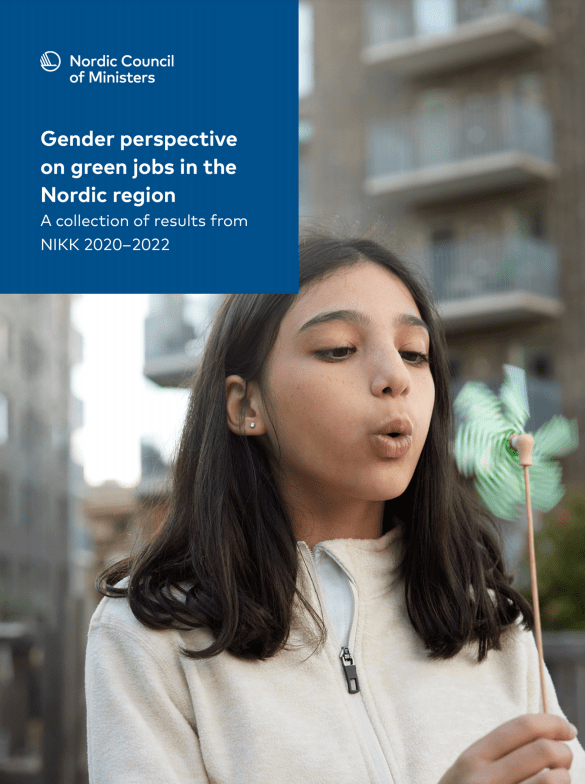
Gender perspective on green jobs in the Nordic region: A collection of results from NIKK 2020–2022
The Nordic Council of Ministers has adopted the vision that the Nordic region will be the most sustainable and integrated region in the world by 2030. This knowledge review sheds light on a number of reports that use gender analyses to help understand the challenges of the green transition. It presents five thematic approaches to green jobs and concludes with a summary and key messages from these reports.
The purpose of this report is to identify links between issues related to gender-segregated educational choices and gender segregation in the labour market related to the transition to green jobs. The hope is that it will help to deepen the Nordic region’s perspectives on these issues and, by extension, contribute to sustainable solutions for social development in the Nordic countries.
Gender perspective on green jobs in the Nordic region: A collection of results from NIKK 2020–2022
- Category: Labour and labour market
- Text: Jimmy Sand
- Published: 2023
- Material Type: PDF/online
10! Ten years of cooperation through the Nordic Gender Equality Fund
When the Nordic Council of Ministers established the Nordic Gender Equality Fund in June 2013, the aim was to stimulate Nordic cooperation in the area of gender equality. Since then, the Fund has granted funding to NGOs, public authorities, researchers and networks within the context of 79 different projects.
In this publication, we present the experiences, insights and effects of these first ten years of the Fund.
The publication in Nordic languages
Finnish:
Kymmenen vuotta yhteistyötä pohjoismaisen tasa-arvorahaston kautta (accessible online version)
PDF in Finnish for print
Icelandic:
Tíu ára samstarf gegnum Norrænan jafnréttissjóð (accessible online version)
PDF in Icelandic for print
10! Ten years of cooperation through the Nordic Gender Equality Fund
10! Ten years of cooperation through the Nordic Gender Equality Fund (PDF print version)
- Category: Gender equality and welfare policy
- Text: NIKK
- Published: 2023
- Material Type: PDF/online
Climate, Gender and Consumption: a research overview of gender perspectives on sustainable lifestyles
Within the Nordic Council of Ministers’ program for sustainable lifestyles in the Nordics, NIKK has produced a research overview to make visible and challenge gender stereotypes in relation to consumption and lifestyle, and contribute to a better understanding of how differences arise, and how they are reinforced and reproduced.
Sustainable production and consumption, goal 12 in Agenda 2030, has been identified as one of the areas where the Nordic countries face the greatest challenges in the work for sustainable development. The overall international research situation regarding the climate impact of individuals’ consumption patterns shows, among other things, that socio-demographic factors such as gender, income and ethnicity have a great explanatory value. Research also shows that inequality itself, especially in high-income countries, leads to increased emissions from consumption.
Climate, Gender and Consumption: a research overview of gender perspectives on sustainable lifestyles

Key takeaways from Climate, Gender and Consumption (PDF print version)
- Category: Gender equality and welfare policyGender research
- Text: Jimmy Sand
- Published: 2022
- Material Type: PDF/online
Towards a sustainable future world of work in the Nordic countries – The gender perspective on the opportunities and challenges
Nordic labour markets and the world of work are facing a variety of challenges, including challenges emanating from technological change, demographic shifts and regional differences. How knowledge, learning and education, and the logics of governance are viewed have all changed. This knowledge base describes these changes and focuses on three challenges for a sustainable world of work:
- Lifelong learning: being schooled in readiness to change
- The significance of place: teleworking and work on site
- Forms of employment and working conditions: the gig economy and entrepreneurship as examples
By identifying the challenges from a gender perspective, one can problematize assumptions about technology-driven social development that have a bearing on the world of work and the supply of skills. They are also seen in relation to policy goals for sustainable economic, social and environmental development. What needs to be done to enable sustainable development based on human rights, gender equality and no one being left behind? In this knowledge base, opportunities and challenges are discussed.

- Category: Labour and labour market
- Text: Susanna Young Håkansson, Ulrika Jansson, Jimmy Sand, Angelica Simonsson
- Published: 2022
- Material Type: PDF/online
Vocational education and training in the Nordic countries – Knowledge and interventions to combat gender segregation
In the Nordic countries, both education and the labour market are strongly gendersegregated. This segregation is both vertical and horizontal, meaning that women are found in different courses and study programmes and sectors of the labour market than men, and also find themselves in different positions in the hierarchies of education systems and working life. This gender segregation has consequences for study and working conditions, pay, and the distribution of power and resources.
Combating gender bias is one of the strategic areas of intervention in official Nordic cooperation in the area of gender equality. The Danish Presidency of the Nordic Council of Ministers in 2020 therefore initiated a project that shed light on gendered educational choices in the Nordic countries. The Nordic Council of Ministers cooperation body Nordic Information on Gender (NIKK), located at the Swedish Secretariat for Gender Research, was commissioned to conduct a study focusing on gender segregation in VET in the Nordic countries.
The study provides an introduction to what we know about VET and gender as an area of knowledge, describes how VET in the Nordic countries is organised, and gives examples of how these countries have worked to break patterns of gender segregation and to retain pupils who belong to the under-represented sex. The study also includes a concluding analysis section which discusses the results of the survey conducted against the background of current knowledge in the field.
Vocational education and training in the Nordic countries – Knowledge and interventions to combat gender segregation

Key points from the report Vocational education and training in the Nordic countries (print version)
- Category: Gender equality and welfare policyLabour and labour market
- Text: Angelica Simonsson
- Published: 2022
- Material Type: PDF/online
Hate crimes targeting LGBTI people in the Nordic countries: A survey of strategies, methods and initiatives
Many LGBTI people in the Nordic countries today experience violence, hate speech, threats and harassment in various forms. This is serious, especially since these crimes are often motivated by hatred of individuals based on their sexual orientation or gender identity. But the Nordic countries are also working to develop long-term policies to improve this situation.
As part of this work, the Nordic Council of Ministers initiated a project that focuses on hatred directed at LGBTI people in the Nordic countries. Nordic Information on Gender (NIKK), located at the Swedish Secretariat for Gender Research, was commissioned to survey relevant strategies, actors and initiatives in the Nordic countries and present the results of this survey in a report.
This survey shows that the majority of countries are working proactively to prevent and identify hate crimes against people based on their sexual orientation or gender identity. This work often involves government agencies and authorities as well as civil society organisations.
The survey also highlights some of the challenges and differences in how the Nordic countries are working to combat hate crime against LGBTI people. Below is a summary of these countries’ initiatives related to hate crime in various areas.
Hate crimes targeting LGBTI people in the Nordic countries: A survey of strategies, methods and initiatives

Hate crimes targeting LGBTI people in the Nordic countries (PDF for print)
- Category: Law and lawsLGBTI
- Text: NIKK
- Published: 2021
- Material Type: PDF/online
Health, well-being and life conditions of young LGBTI persons in the Nordic countries
Despite the fact that life conditions of LGBTI persons in the Nordic countries have changed in the last seventy years, major public health surveys indicate that this group suffers from an increased amount of mental and physical health issues compared to the rest of the population.
Younger generations of LGBTI persons see their lives affected, too, by having a sexuality or gender identity that falls outside heteronormativity. Among other factors, this is due to the exposure to stress that LGBTI persons experience in daily life, so-called minority stress. This includes the risk of or actual harassment, vulnerability, and violence. Further, it includes facing prejudice and discrimination in everyday life, having to sometimes conceal your identity, and dealing with internalized homo- and transphobia, which in turn have detrimental effects on health.
The Nordic Council of Ministers, therefore, has initiated a project that aims to shed light on the well-being of young LGBTI persons. The purpose of the project is to promote knowledge and experiences in the region, in order to contribute to improved life conditions for young LGBTI persons in the Nordic countries. Nordic Information on Gender, NIKK, has carried out the project, which has resulted in the report at hand.
The report consists of two parts:
- A literature review describing the current state of research regarding the wellbeing of young LGBTI persons in the Nordic countries, and
- A survey, presenting a selection of efforts aimed to improve the well-being of young LGBTI persons in the Nordic countries.
Summaries of the report in Nordic languages
Health, well-being and life conditions of young LGBTI persons in the Nordic countries

- Category: Children and youthLGBTI
- Text: Anna Siverskog & Ida Måwe
- Published: 2021
- Material Type: PDF/online
Gender equality effects of COVID-19 – Knowledge and initiatives in the Nordic countries
How are the Nordic countries handling the effects of COVID-19 on gender equality? The COVID-19 pandemic is presenting new challenges for gender equality, which has loomed large in Nordic gender equality co-operation since the outbreak of the pandemic. The risk of increased domestic violence when the community partially shuts down to reduce the spread of infection. Working life and the economy, unpaid care work and mental health issues are also areas that have been largely affected by the pandemic.
This publication summarises the knowledge produced thus far in the Nordic countries and brings together the gender equality initiatives and measures that the Nordic countries have initiated in relation to the pandemic. The publication aims to contribute to the sharing of knowledge and experience between the Nordic countries arising from the effects of the pandemic on gender equality. By learning from each other, the Nordic countries can decrease the risk for that the Corona crisis become a gender equality crisis.
The publication has been produced by Nordic Information on Gender (NIKK) and is based on data from the Nordic countries as well as interviews with researchers and experts.

- Category: Gender equality and welfare policy
- Text: Anna Dahlqvist
- Published: 2021
- Material Type: PDF/online
Co-operation for gender equality in working life

This summary presents results from co-operation projects financed by the Fund that have contributed to gender equality in the workplace. The purpose of this summary is to share knowledge and experience from these projects in order to increase their impact so that they will benefit more people, and to inspire others to participate in Nordic co-operation projects.
The summary has been prepared by Nordic Information on Gender (NIKK), which is a co-operation body under the Nordic Council of Ministers. NIKK has the task of managing the Nordic Gender Equality Fund.
- Category: Gender equality and welfare policyLabour and labour market
- Text: Susanna Young Håkansson & Elin Engström
- Published: 2020
- Material Type: PDF/online