
Gender segregation in VET focus of new report

Both the labour markets and the education systems in the Nordic countries are highly gender-segregated. This is particularly apparent in vocational education and training (VET). NIKK´s report describes the state of knowledge and the education systems across the Nordic countries, and providing examples of existing interventions to break patterns of gender segregation in VET in these countries.
Women and men are found in different courses and study programmes and sectors of the labour market, and also end up in different positions in the hierarchies of both the education systems and working life. This gender segregation has consequences for study and working conditions, pay, and the distribution of power and resources. VET programmes involve many practices where sex and gender have significance, and where gender segregation is particularly apparent.
Tasked by the Nordic Council of Ministers, NIKK has produced the report “Vocational education and training in the Nordic countries – Knowledge and interventions to combat gender segregation”. The report describes the current state of knowledge and the education systems in the Nordic countries. It also provides examples of existing interventions aiming to break patterns of gender segregation in VET programmes in the Nordic countries. The final part of the report analyses each of its parts and presents recommendations and overall reflections on what needs to be taken into account in future work for change.
Few interventions focus on gender coding
In the Nordic countries, interventions to reduce gender imbalances in working life and education are largely implemented as part of overall policy strategies. Some interventions target specific sectors. The report shows that many of these interventions to counter gender segregation aim to encourage the under-represented sex to choose differently. However, few of them focus on the gender coding that exists and is reproduced in VET programmes and in the workplaces associated with them.
“Gender coding is closely tied to how work is valued. Traditions, tasks and cultures in these occupations and in VET are associated with masculinity or femininity. This does not automatically change when the proportion of women or men in a particular sector changes,” says Angelica Simonsson, PhD in education and senior analyst at the Swedish Secretariat for Gender Research, who wrote the report.
Many similarities and differences in the Nordic countries’ education systems
The education systems in the Nordic countries have many fundamental similarities, but also many differences, especially when it comes to the way in which VET programmes are organised. All these education systems have in common that they have always had the fundamental idea that social disparities can be addressed through education. Common to all the Nordic countries is that they have a universal education system where all pupils attend compulsory school together. When pupils are roughly 15-16 years old, they transition to upper secondary school. There, they can choose between a stream that leads to university studies or a VET stream, or a combination of both. One of the major differences between the countries is how strong the divide is between these two streams, and being able to study for entry to university studies for those who choose a VET programme.
“This is linked in part to the countries’ different ways of dealing with the issue of social inclusion and equity,” continues Angelica Simonsson.
One of the most striking similarities in VET in the Nordic countries is the numbers of boys and girls studying in different VET areas. The report presents statistics which show great similarities in the areas where boys dominate and where girls dominate, and that boys generally exhibit a greater dominance. At the same time, the subject areas involve different things in the different countries and are therefore not entirely comparable. Overall however, it can be said that there is an almost total dominance of boys in the energy, industry, building and construction sectors. Girls instead dominate in the area of health and social care. In sectors such as service and administration, there is a greater gender balance.
A more comprehensive focus on norms is needed
There are several explanatory models for why gender segregation in VET occurs. What is clear is that sex, gender, VET and work are interlinked. The explanations form a complex fabric in which the individual level and societal level interact; in which policy, governance and labour market forces interact; and in which the individual’s choices are constrained and curtailed both directly and indirectly. A focus on individuals alone within the under-represented group in a particular sector appears to be a poor solution to the problem.
“Instead, a more comprehensive and distributed focus on norms and attitudes is needed, targeting actors and practices at a number of levels in the labour market and in these countries’ education systems,” says Angelica Simonsson.
- Text: NIKK
- Photo: norden.org
- Categories: Gender equality and welfare policy, Labour and labour market
- Published: 2022-03-08
An accessible version of the publication(in English) can be found here.
Read about the Nordic Gender Equality Fund in four languages

1st of March, the Nordic Gender Equality Fund opens for applications for funding. We have gathered information about the new fund in a message available in English, Finnish, Icelandic and Swedish.
The Nordic Gender Equality Fund finances collaborations that promote gender equality. Through the Fund, the Nordic Council of Ministers issues an annual call for proposals for funding projects in which at least three organisations, from at least three Nordic countries, collaborate. NIKK is tasked to administrate the fund. It opens for applications for funding March 1 2022.
All information about the fund is now gathered in a message available in English, Finnish, Icelandic och Swedish.
- Text: NIKK
- Photo: Unsplash
- Categories: Gender equality and welfare policy, Nordic Gender Equality Fund
- Published: 2022-02-09
Mobilising against hatred and harassment during the Finnish Presidency

Over the past year, the Nordic countries have taken joint action to promote gender equality. Police officers as well as preschool teachers have been invited to share experiences and find solutions with their Nordic colleagues.
Over the past year, the Nordic countries have taken joint action to promote gender equality. Police officers as well as preschool teachers have been invited to share experiences and find solutions with their Nordic colleagues.
2021 is now over. The Finnish Presidency has rounded off a year in which there have been many opportunities to learn from each other in the area of gender equality and LGBTI issues in the Nordic region.
Hanna Onwen-Huma, Chair of the Nordic Committee of Senior Officials for Gender Equality and LGBTI (ÄK-JÄM), mention the two-day conference ‘Gender-based Hate, Threat and Harassment on the Internet’ in the summer as an example.
“Victimisation online is a problem we see across the Nordic region, and we can benefit from looking at each other’s work,” she says.
The key takeaways from the conference have been summarised by independent expert Elina Nikulainen. Hanna Onwen-Huma believes that the police in the Nordic countries can benefit greatly from working together to find solutions.
“We see that online harassment often falls through the cracks with the police. Their work is divided up in such a way that some work on cybercrime and others on sexual harassment, and they do not interact. This is a problem throughout the Nordic region,” she says.
Focus on early childhood education
Another issue that has been in focus during the Finnish Presidency is gender equality in early childhood education. The work in the Nordic region has been mapped in the report “Changing Stereotypes and Breaking Traditions”. Using the report as a starting point, a seminar was held in early September for preschool teachers on how they can improve the preschool’s gender equality efforts in relation to the children.
“This is an important question because we know that what we learn as children influences the life choices we see as possible, and this is also reflected later in life,” says Hanna Onwen-Huma.
Hate targeting LGBTI people
In the LGBTI area, the Nordic Council of Ministers has a particular focus on hate crime in 2021. A survey was carried out on what different countries are doing in this area, and a seminar was held at the end of November focusing on successful examples.
“It brought together different actors such as police officers and representatives of LGBTI organisations. I think it was very fruitful,” says Hanna Onwen-Huma.
One challenge in the work to prevent hate crime is that many victims do not report it to the police.
“We need to change this, and we can see that the results are better when the police and LGBTI organisations work together,” says Hanna Onwen-Huma.
Online during the pandemic
Many of the activities during the year had to be carried out online due to the pandemic.
“In practical terms, this meant extra work as we had to reschedule several times at the last minute, but I don’t think the quality has suffered,” says Hanna Onwen-Huma.
The only event it was not possible to hold was the conference ‘Nordic Fathers on Paternity Leave’. It was due to be held in 2021 but has been postponed until March 2022.
Norway takes over the Presidency of the Nordic Council of Ministers for 2022.
“They have excellent plans for the area of gender equality next year,” says Hanna Onwen-Huma, and explains that these include looking more closely at the anti-gender debate from a global perspective.
“The Nordic countries will join forces to see how we can fight against this movement, which is attacking the work to strengthen the rights of girls, women and LGBTI people.”
- Text: Charlie Olofsson
- Photo: Inga-Seliverstova/Pexels
- Categories: Gender equality and welfare policy
- Published: 2022-01-11
Apply for funding for Nordic co-operation in the gender equality and LGBTI area
Next year, NIKK will open up the possibility of applying for funding for Nordic co-operation in the gender equality and LGBTI area again. As in previous years, actors from at least three Nordic countries are required to participate in the application. In total, nearly 3,6 million Danish kroner will be distributed.
In order to be granted funding from the Nordic Gender Equality Fund or the Nordic LGBTI Fund, the planned activity needs to start in 2022 and be completed within two years. The funds can, for example, be used to develop joint methods, develop new knowledge or arrange conferences and networks. The application is made through a form that is available on nikk.no during the application period.
Important dates for the Nordic Gender Equality Fund
- March 1 – Application opens
- March 31 – Last day for application
- May – June – Decision is notified to applicants
- June – Project agreements concluded.
Read more about the Nordic Gender Equality Fund
Important dates for Nordic LGBTI fund
In the autumn of 2022, it will be possible to apply for funding from the Nordic LGBTI Fund, which aims to promote Nordic co-operation in the LGBTI area. Projects that contribute to the work for LGBTI people’s equal rights, treatment and opportunities in the Nordic region can apply for funding. In total, 1,6 million DKK will be distributed.
- September 1 – Application opens
- September 30 – Last day for application
- November/December – Decisions are notified to applicants
- November/December – Project agreements concluded.
- Text: NIKK
- Categories: Gender equality and welfare policy
- Published: 2021-12-17
The Nordic countries are combating hate crime targeting LGBTI people

The Nordic countries are among the most progressive in the world when it comes to the health and well-being of LGBTI people. Yet many are exposed to violence, hatred, intimidation and harassment because of their sexual orientation or gender identity. A new report has just been released which sheds light on this situation.
The report entitled Hate crimes targeting LGBTI people in the Nordic countries describes how these countries are working to capture and combat hate crime targeting LGBTI people and points out important actors, strategies and legislation.
– All people should be able to live and work in the Nordic countries without fear of hatred, threats and discrimination. This report gives us a better basis for improving the situation of LGBTI people by pointing to what efforts are needed. For example, decision makers, the authorities and civil society all need to work together in better ways, says Thomas Blomqvist, Finland’s Minister for Gender Equality.
The report presents how the police and the legal system work when it comes to hate crimes in each country for example. It also gives examples of knowledge-enhancement initiatives and support for victims of crime. The role and efforts of civil society are also a focus.
Preventive efforts common
A somewhat positive picture of the trend in the Nordic countries in recent decades emerges from the report, which names new legislation protecting LGBTI people against hatred and discrimination as a contributing factor to this. The majority of these countries are also working to prevent and identify hate crimes against people based on their sexual orientation or gender identity. Often, a number of authorities and civil society organisations are involved in this work.
Other factors that point in a positive direction are that hate crimes are prioritised by the police in many of these countries. It is also common to keep statistics on how often and where hate crimes take place in order to enhance knowledge about them. Many of these countries are also engaged in knowledge-enhancing measures which aim to get more people to report these crimes, or to improve the skills of those who encounter the victims of these crimes in their work.
A number of challenges for these countries in combating hate crime emerge from the report – challenges related to the work of the police and how cooperation between different actors functions. Examples of these challenges are that the police sometimes fail to recognise hate motives in crimes, and that those groups that are particularly at risk of hate crime often lack confidence in the police. These are factors which make it more difficult to solve hate crimes. The report also highlights the need to improve cooperation between the police and civil society crime victim support activities.
Several initiatives to improve the situation of LGBTI people in the Nordic countries
This report is one of several initiatives within the framework of the regional LGBTI strategy adopted by the Nordic Council of Ministers in 2020. Previous initiatives have focused on the health and well-being of young LGBTI people and next year a research review of the living conditions of older LGBTI people is planned. The report Hate crimes targeting LGBTI people in the Nordic countries was produced by Nordic Information on Gender (NIKK) on behalf of the Nordic Council of Ministers.
It will be presented in conjunction with the Nordic Council of Ministers’ seminar LGBTI People’s Safety and Well-being – Good Practices in the Nordics held in Helsinki on 30 November.
- Text: NIKK
- Categories: Gender equality and welfare policy, LGBTI
- Published: 2021-11-30

Read the full report here (PDF)
An accessible version of the publication can be found here
Gender perspectives on sustainability focus of new project

How can we enable sustainable living in the Nordic region? How can we better understand how differences in lifestyle arise? This is the focus for the project Sustainability, lifestyles, and consumption from a gender perspective, which is a part of the cross-sectoral Sustainable lifestyles in the Nordic region programme. The project is implemented by NIKK, tasked by the Nordic Council of Ministers. It starts during autumn 2021.
In a mapping, differences in women’s and men’s lifestyles and consumption in the Nordic countries will be examined. Through current knowledge, the mapping aims to make gender stereotypes visible and challenged in relation to consumption and lifestyle, and contribute to a better understanding of how differences arise, are strengthened and reproduced.
‘The project aims to illustrate gender differences in lifestyles and consumption and the need for future policies and practices to integrate gender aspects into sustainable consumption. As gender equality is key in order to achieve a sustainable Nordic region, the project contributes greatly to the vision of the Nordic Council of Ministers of becoming the most sustainable and integrated region in the world in 2030’, says Kristin Mattsson, steering group member of the cross-sectoral Nordic programme.
Sustainability and lifestyle concepts will be studied and analysed from a broad intersectional gender perspective, in relation to themes raised in the cross-sectoral program on sustainable lifestyles. These can be, for example, communication about sustainability, education for sustainability, sustainable cultural and food experiences.
Critical and intersectional perspectives will be included thoroughly to make visible and problematize how different power structures intersect, for example how class and age affect both consumption habits and norms around consumption.
By analysing sustainability and lifestyle from a gender perspective, the project contributes to improving understanding and opportunities for sustainable consumption. The knowledge mapping will be launched in autumn 2022.
About the Sustainable lifestyles in the Nordic region programme
The cross-sectoral programme Sustainable lifestyles in the Nordic region programme is a collaboration between the Nordic co-operations for sustainable development, environment and climate, food, culture, education and research, gender equality and Nordbuk, the Nordic committee for children and youth. The programme is carried out 2021-2024 and aims to make it easier and more attractive for Nordic consumers to prioritise healthy and climate and environmental friendly choices. Through several cross-sectorial initiatives, it will contribute to fasten the normalisation of sustainable lifestyles in the Nordic region.
The programme, as well as the project focusing on gender perspectives on sustainably contribute to the Nordic vision, especially the part concerning a green Nordic region, as well as several of the Sustainable Development Goals in Agenda 2030.
- Text: Susanna Young Håkansson
- Photo: Josh Willink, Pexels
- Categories: Gender equality and welfare policy, Sustainability
- Published: 2021-11-11
New co-operation projects strengthen gender equality in the Nordic region

Who commits gendered online abuse – and how can the harm be curbed? Those are issues in focus by one of the six projects that have been granted funding from the Nordic Gender Equality Fund 2021. Another project will develop a Nordic method to create an inclusive and gender equal school, with a focus on student participation.
During spring 2021, the Nordic Gender Equality Fund was open for applications for funding for the ninth year in a row. The call for proposals has resulted in six new, Nordic co-operation projects in the gender equality area. Read more about the projects and their work on the projects’ respective pages.
Projects granted funding by the Nordic Gender Equality Fund 2021
- Inclusive Mediation to Sustain Peace
- New Nordic Narratives – changing our future story landscape
- Profiling Nordic Perpetrators of Gendered Online Abuse: Who, Why and How to Curb the Harm
- Recognising Sexual Violence: Developing Pathways to Survivor-Centred Justice
- Safe Schools – A Nordic Method for Student Participation and Norm Criticism
The Nordic Gender Equality Fund is administrated by NIKK on behalf of the Nordic Council of Ministers. Information about the call for proposals for 2022 will be available later on this year. Read more about the fund here.
- Text: Susanna Young Håkansson
- Categories: Gender equality and welfare policy, Nordic Gender Equality Fund
- Published: 2021-11-01
Apply for research funds for new knowledge about sexual harassment in working life

Today, studies on the prevention of sexual harassment in workplaces in the Nordic countries are largely lacking. Knowledge is needed about why they work or not, about who is reached and not reached through the preventive work. Today, 26 August, the second of two calls opens within the framework of a Nordic research initiative, focusing on these issues.
In order to develop new and effective efforts to combat sexual harassment in the workplace, evidence- and research-based knowledge is essential. In light of this, the Nordic Council of Ministers has decided to support a Nordic research initiative, in co-peration between several sectors within the Nordic collaboration. Sectors involved include gender equality, culture, working life and the Nordic Committee for Children and Young People. The research initiative consists of two open calls for proposals, both launched in 2021.
“Open Call 2 is aimed at researchers and working life actors in the Nordic region who intend to initiate practice-oriented research activities with high quality, in close collaboration. The projects should have a Nordic benefit by contributing with new knowledge on sexual harassment in the workplace in the Nordic region”, says Maria Grönroos, co-ordinator for the research initiative, administered by NIKK, Nordic Information on Knowledge on gender.

Industry-specific or industry comparative approach
Industries face in part different, and in part, similar challenges. There is therefore potential for synergies if local analyses are also tied to more generic knowledge about sexual harassment and interventions, and if co-operation between industries occurs. Comparisons between different industries could provide a clear understanding of industry-specific and cross-industry challenges and opportunities. The applications should be based on partnership between at least three Nordic countries/areas of the Nordic region.
Interdisciplinarity, intersectionality and defining concepts
Sexual harassment in the workplace touches on many areas of knowledge – from work sciences research to research on health, organisations, power, violence, etc. For sustainable and robust knowledge, proposals are encouraged to include interdisciplinary approaches to their projects.
Intersectional approaches where aspects of a person’s social and political identities combine to create different discrimination modes and privilege are relevant to managing sexual harassment at work.
“International research shows that people belonging to minority groups, or at risk of harassing due to attributes such as age, disability or sexuality, also have greater risk of being sexually harassed. Proposals are encouraged to address the diversified and complex reality in working life to contribute to well-targeted and effective prevention and new intervention methods”, says Maria Grönroos.
The lack of clear definitions of concepts related to sexual harassment makes it difficult to work in the area. The legal construction of the term sexual harassment provides limited space to understand the phenomenon or what the victim experiences sexual harassment. A recommendation is to require reflection and clarity of the use of terms and interpretation of these conditions in the projects.
Digital information meeting on 2 September
A digital info meeting will be organised for those who have questions about the call and plan to apply: Thursday, 2 September, 13.00-14:30 CET .
Interested in participating? Please email maria.gronroos@genus.gu.se no later than 30 August.
NIKK is a Nordic cooperation body under the Nordic Council of Ministers. NIKK collect and disseminate knowledge about politics and practice, facts and research in the area of gender equality in a Nordic perspective.
- Text: Jessica Glanzelius
- Photo: Ragnhild Fjellro
- Categories: Gender equality and welfare policy, Sexual harassment
- Published: 2021-08-26
New Nordic fund to promote equal rights for LGBTI people
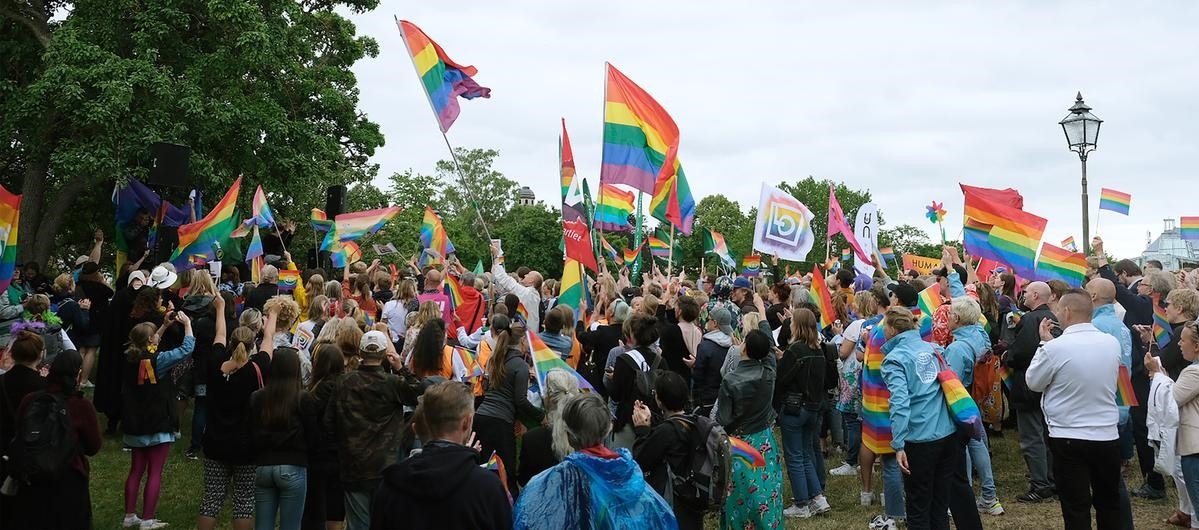
Since 2020, the Nordic countries have been working together to ensure that LGBTI people have equal rights, equal treatment and equal opportunities in the region. This year, calls for proposals to finance projects from the Nordic LGBTI Fund are being issued for the first time. The Fund aims to promote Nordic efforts to improve conditions for LGBTI people.
The strategy for new Nordic co-operation on improving conditions for LGBTI people will be put into effect in 2021. Part of this work is the new Fund, which aims to promote Nordic co-operation in the LGBTI area.
“LGBTI people should be able to live free, open and good lives in the Nordic countries. The Nordic LGBTI Fund is an important part of achieving this. The Fund is a unique way of supporting work for change in the Nordic countries in the LGBTI area,” says Thomas Blomqvist, Finland’s Minister for Nordic Co-operation and Gender Equality.
Projects that contribute to work for equal rights, equal treatment and equal opportunities for LGBTI people in the Nordic countries can apply for financing from the Fund. A total of DKK 238,000 will be distributed. NIKK is the administrator of the Nordic LGBTI Fund on behalf of the Nordic Council of Ministers and will accept applications after the summer of 2021.
As with the Nordic Gender Equality Fund, actors from at least three Nordic countries need to be involved in each application. Thanks to this co-operation, knowledge is growing and being shared across borders. We are finding common solutions and learning from each other. The activities should start during 2021 and are to be carried out within two years. The funding can be used to develop common methods and new knowledge, and to hold conferences and build networks, etc.
“The new Fund will strengthen the work to ensure equal rights, equal treatment and equal opportunities for LGBTI people in the Nordic countries. We know that there is a great deal of expertise, knowledge and the will to drive this development forward, in particular in civil society. And we hope that this will be reflected in the applications received,” says Thomas Blomqvist.
Preliminary important dates for the Nordic LGBTI Fund
You need to apply via a form, which will be available from nikk.no during the application period.
- 1 September – the call opens
- 30 September – deadline for applications
- November/December – decisions notified to applicants
- December – contracts will be signed
-
Text: Susanna Young Håkansson
Photo: norden.org - Photo: Martin Zachrisson/norden.org
- Categories: Demographics, Gender equality and welfare policy, LGBTI, Nordic LGBTI Fund
- Published: 2021-05-05
New report gives gender perspectives on the high-tech labour market of the future

How will gender equality and sustainability be achieved in the high-tech labour market of the future? A new report examines how the Nordic countries are working to break down gender segregation in natural scientific and technical fields (STEM). The report shows that many initiatives are based on the assumption that the solution is to ‘fix women’. This renders gender inequality and structural barriers invisible.
On assignment from the Nordic Council of Ministers, NIKK has produced the report Genusperspektiv på framtidens högteknologiska arbetsliv – En nordisk forskningsöversikt om utbildningsval inom STEM (Science, Technology, Engineering and Mathematics) [Gender perspective on the high-tech labour market of the future – A Nordic research overview on education choices within Science, Technology, Engineering and Mathematics (STEM)]”. The report provides an overall picture of what the research says, and make an inventory and analysis of initiatives in the STEM sector in the Nordic countries. An international outlook gives examples of how countries outside the Nordic countries are handling skewed recruitment to the STEM area.
“The picture is clear. Globally as well as in the Nordic countries, these initiatives generally aim in various ways to change girls and women rather than challenge gendered privilege, organisations or the gender norms surrounding science, technology, engineering, mathematics and other science subjects. This renders the structural barriers that exist invisible,” says Ulrika Jansson, who wrote the report together with Jimmy Sand.
Furthermore, in these initiatives, there is an assumption that women need to be inspired and supported through role models and mentoring.
“Most likely some of these initiatives do help girls and women to fit into courses and study programmes and professions dominated by men and a masculine subject area and occupational culture. But they are unlikely to challenge either established privilege or norms, nor to lead to radical change in mainstream activities and the organisation of work,” says Ulrika Jansson.
The need for a broader approach
The report shows that a much broader approach is needed. Looking at the situation from an organisation theory gender perspective, clear patterns emerge. Explanatory models for gendered study choices, gender-segregated labour markets and gender imbalance in the STEM area show very clearly that notions, assumptions and norms about gender, women and men, femininity and masculinity, set the framework and stipulate the terms for people’s scope for action. Heterosexuality is the norm and ethnicity or functional diversity is in principle not visible at all.
“Connections between men, masculinity and technical knowledge are created in everyday practices and are neither natural nor universal. These connections are made in a variety of ways, by different actors and in different contexts,” says Jimmy Sand.
In addition, there are norms in the education system, with gendered ideals of science, knowledge and science subjects that create limits for inclusive and sustainable education and a sustainable working life.
“All in all, these norms set the terms for both men’s and women’s study and career choices and in the labour market, at both the individual and structural levels. Terms where the outcome does not benefit women, but does benefit men,” says Jimmy Sand. For a sustainable and gender-equal working life in the future, it is important to ask other questions about skills and occupations as well, the report shows. How will the Nordic countries’ skills supply be guaranteed and what might this look like in order to increase gender equality? What types of skills do the Nordic countries need, apart from more engineers?
The research overview that is the central part of this report is based on a systematic review of 199 articles published in scholarly journals published during the period 2000–2019.
-
Text: Susanna Young Håkansson
Photo: RF._.studio/Pexels - Categories: Gender equality and welfare policy, Labour and labour market
- Published: 2021-05-03
